← Go Back

← Go Back
View full details
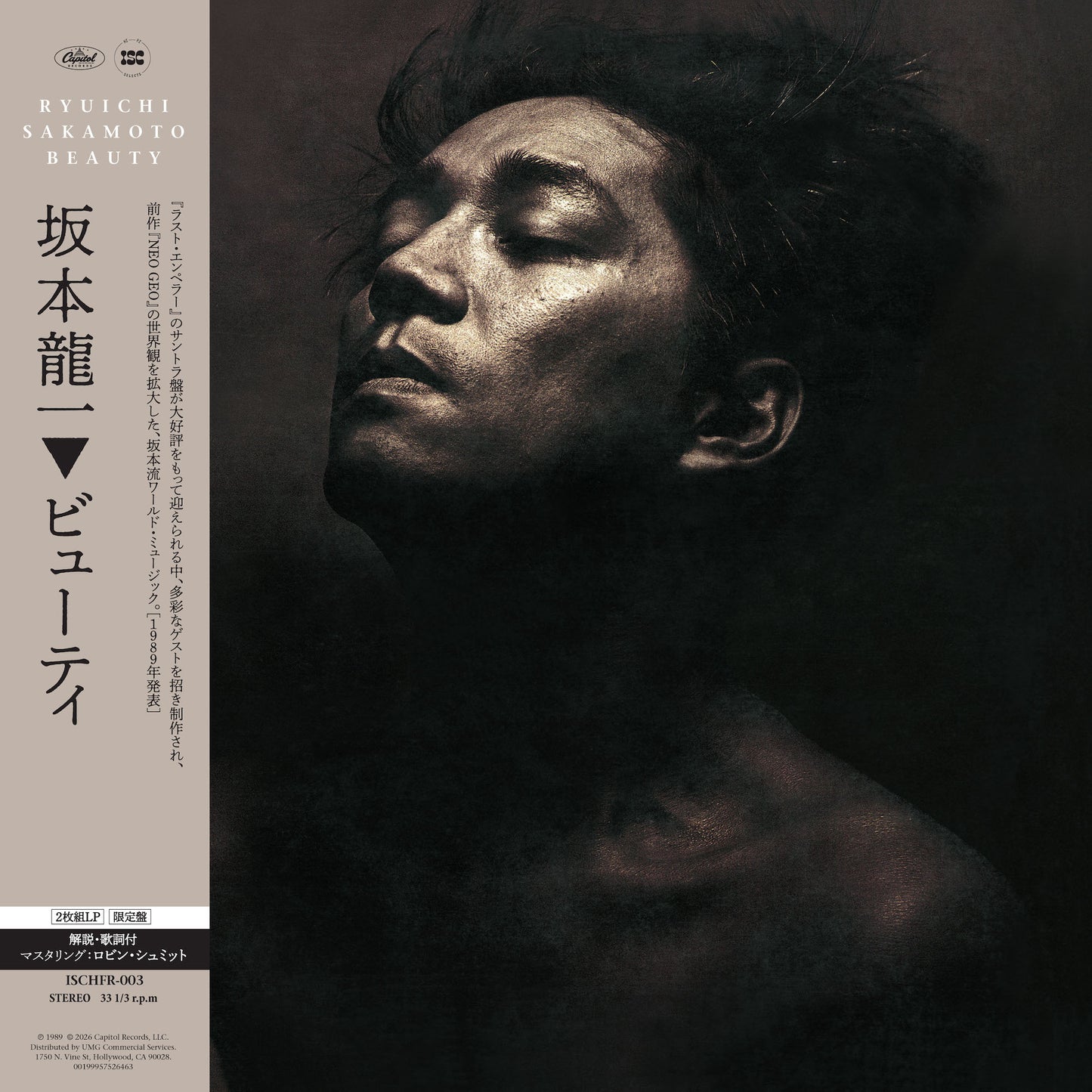
Ryuichi Sakamoto – Beauty (2LP)
Ryuichi Sakamoto – Beauty (2LP)

Ryuichi Sakamoto – Beauty (2LP)
Ryuichi Sakamoto – Beauty (2LP)
Style:
Rock / Pop / Folk, Electronic
Label:
ISC Hi-Fi Selects, Capitol Records
Catalog Number:
ISCHFR-003, 00199957526463
Release Date:
July 17, 2026
Format:
Vinyl LP, 2LP
Regular price
$40.00
Regular price
Sale price
$40.00
Unit price
per
Shipping calculated at checkout.
Couldn't load pickup availability
Description
Ryuichi Sakamoto's 1989 Outernational Masterpiece Beauty Returns to Vinyl in a Definitive 2LP Edition.
An underrated gem from the Yellow Magic Orchestra legend’s vast discography, Beauty expands on the Okinawan themes of Neo Geo with an all-star “outer-national” collaborator list including: Brian Wilson (Beach Boys), Robert Wyatt, Sly Dunbar, Arto Lindsay, Youssou N'Dour, Pino Palladino, along with Korean and Chinese instrumentalists.
By the end of the 1980s, Ryuichi Sakamoto had become one of the rare musicians with the experience, reputation and ambition to imagine music on a truly global scale. Even as Yellow Magic Orchestra was reshaping electronic pop, he was venturing far beyond Japan, recording portions of 1980's B-2 Unit in London with dub pioneer Dennis Bovell before traveling to Düsseldorf to work at Kraftwerk's Kling Klang Studio. The resulting music fused electro, dub and Afrobeat years before such combinations became commonplace.
His orbit only widened. Sakamoto scored Merry Christmas, Mr. Lawrence, appearing alongside David Bowie while launching a lasting collaboration with David Sylvian, produced Virginia Astley's Hope in a Darkened Heart and continued working with artists including Akiko Yano, Thomas Dolby and Iggy Pop. For his 1987 album, the Bill Laswell-produced NEO GEO, Sakamoto filled his work with New York sample culture and harder rhythms. By the time his Academy Award-winning score for The Last Emperor established him as one of the world's leading film composers, he was jet-setting between Tokyo, London, Rome and New York, building an international creative network unlike any of his contemporaries.
That decade of travel, collaboration and restless curiosity had given Sakamoto a musical vocabulary by 1989 as expansive as his passport. Beauty would become its fullest expression.
Beauty was built amid a slower kind of globalization. Long before files could be shared online, Sakamoto carried tapes and floppy disks between Tokyo and New York, stitching together an international cast one studio, session and flight at a time. The resulting album felt almost impossible for its era: musicians from four continents, disparate musical traditions and an astonishing roster of players.
"One of my friends, he's a philosopher and critic,” Sakamoto told writer and musician David Toop in Toop’s book Ocean of Sound. “He made a word: 'outernationalism.' Internationalism is still based on nationality. Being outernational is like Moses in the desert. There's no country. There is just trade, communication and merchants, but there's no nationality. It's a utopia and I like it."
Sakamoto recorded Beauty mostly in New York, which he called “the centre of the world” during a 1989 interview with Sound on Sound. “It's so easy to get a musician quickly if you are working there. One day in the studio, for instance, I found I needed an African guitarist. So I called Verna Gillis, who's an ethnic music coordinator, a great researcher, who brought an African guitar player into the studio the very next day.” He did the same for Korean and Chinese instrumentalists.
Working with engineer Jason Corsaro, Sakamoto opened the studio to invention and spontaneity. Musicians improvised, Corsaro synchronized performances across 24- and 48-track machines and Sakamoto shaped the results into finished compositions. "We must record everything which happens in the studio," Sakamoto explained of his process. "The record button had to be hit every time, because nobody knows what incredible things might happen."
The sessions stretched from March through the end of 1989, even as Sakamoto completed the score to The Handmaid's Tale. He approached the mixing console with the same intensity he brought to composition. "Mixing, for me, is the same as conducting," he said. "It is the point where music can be made or killed, a crucial stage."
Poetry proved just as important as technology. Sakamoto and co-producer Arto Lindsay spent the sessions reading English translations of haiku and Zen poetry, searching for an aesthetic that prized simplicity without sacrificing meaning. "The music should speak for itself and the lyrics should be very abstract and romantic," Sakamoto said. "That is the key concept for Beauty, and the Haiku taught us many ways to achieve it."
"Futique" unfolds atop a loping rhythm, with Arto Lindsay's lyrics drifting through Sakamoto's keyboards, Puerto Rican percussionist Milton Cardona's hand drums, Indian violinist L. Shankar's soaring lines and guitar by Japanese musician Bun Itakura, a veteran of Tokyo's post-punk and new wave scene.
The percussive follow-up, "Amore," expands the album's reach even further. Lindsay's lyrics ride rhythms from Cardona, Senegalese talking drummer Magatte Fall and Burkinabè percussionists Paco Yé, Seidou Outtara and Sibiri Outtara, while Lindsay, Sakamoto and Youssou N'Dour share vocals.
With the exception of contributions from Brian Wilson and Robert Wyatt for a cover of the Rolling Stones’ lysergic “We Love You,” Sakamoto completed Beauty in New York. "Because Robert is still a communist, he could not enter America," Sakamoto said, "so I had to send a tape to him where he lives." Sakamoto recruited Wyatt because, as he wrote the singer, "I want the saddest voice in the world to sing it, and that's your voice." Wilson fulfilled another longtime ambition. Recording in Los Angeles during the height of Eugene Landy's controversial influence, Sakamoto called the sessions "very, very hard," but added, "Brian can still sing, and to get him into the music was the objective." "The track was worth it," he said. "I was pretty happy."
More than 35 years after its release, Beauty remains one of the most audacious records of Sakamoto's career, a work that imagined music beyond borders long before globalization became a cultural cliché.
An underrated gem from the Yellow Magic Orchestra legend’s vast discography, Beauty expands on the Okinawan themes of Neo Geo with an all-star “outer-national” collaborator list including: Brian Wilson (Beach Boys), Robert Wyatt, Sly Dunbar, Arto Lindsay, Youssou N'Dour, Pino Palladino, along with Korean and Chinese instrumentalists.
By the end of the 1980s, Ryuichi Sakamoto had become one of the rare musicians with the experience, reputation and ambition to imagine music on a truly global scale. Even as Yellow Magic Orchestra was reshaping electronic pop, he was venturing far beyond Japan, recording portions of 1980's B-2 Unit in London with dub pioneer Dennis Bovell before traveling to Düsseldorf to work at Kraftwerk's Kling Klang Studio. The resulting music fused electro, dub and Afrobeat years before such combinations became commonplace.
His orbit only widened. Sakamoto scored Merry Christmas, Mr. Lawrence, appearing alongside David Bowie while launching a lasting collaboration with David Sylvian, produced Virginia Astley's Hope in a Darkened Heart and continued working with artists including Akiko Yano, Thomas Dolby and Iggy Pop. For his 1987 album, the Bill Laswell-produced NEO GEO, Sakamoto filled his work with New York sample culture and harder rhythms. By the time his Academy Award-winning score for The Last Emperor established him as one of the world's leading film composers, he was jet-setting between Tokyo, London, Rome and New York, building an international creative network unlike any of his contemporaries.
That decade of travel, collaboration and restless curiosity had given Sakamoto a musical vocabulary by 1989 as expansive as his passport. Beauty would become its fullest expression.
Beauty was built amid a slower kind of globalization. Long before files could be shared online, Sakamoto carried tapes and floppy disks between Tokyo and New York, stitching together an international cast one studio, session and flight at a time. The resulting album felt almost impossible for its era: musicians from four continents, disparate musical traditions and an astonishing roster of players.
"One of my friends, he's a philosopher and critic,” Sakamoto told writer and musician David Toop in Toop’s book Ocean of Sound. “He made a word: 'outernationalism.' Internationalism is still based on nationality. Being outernational is like Moses in the desert. There's no country. There is just trade, communication and merchants, but there's no nationality. It's a utopia and I like it."
Sakamoto recorded Beauty mostly in New York, which he called “the centre of the world” during a 1989 interview with Sound on Sound. “It's so easy to get a musician quickly if you are working there. One day in the studio, for instance, I found I needed an African guitarist. So I called Verna Gillis, who's an ethnic music coordinator, a great researcher, who brought an African guitar player into the studio the very next day.” He did the same for Korean and Chinese instrumentalists.
Working with engineer Jason Corsaro, Sakamoto opened the studio to invention and spontaneity. Musicians improvised, Corsaro synchronized performances across 24- and 48-track machines and Sakamoto shaped the results into finished compositions. "We must record everything which happens in the studio," Sakamoto explained of his process. "The record button had to be hit every time, because nobody knows what incredible things might happen."
The sessions stretched from March through the end of 1989, even as Sakamoto completed the score to The Handmaid's Tale. He approached the mixing console with the same intensity he brought to composition. "Mixing, for me, is the same as conducting," he said. "It is the point where music can be made or killed, a crucial stage."
Poetry proved just as important as technology. Sakamoto and co-producer Arto Lindsay spent the sessions reading English translations of haiku and Zen poetry, searching for an aesthetic that prized simplicity without sacrificing meaning. "The music should speak for itself and the lyrics should be very abstract and romantic," Sakamoto said. "That is the key concept for Beauty, and the Haiku taught us many ways to achieve it."
"Futique" unfolds atop a loping rhythm, with Arto Lindsay's lyrics drifting through Sakamoto's keyboards, Puerto Rican percussionist Milton Cardona's hand drums, Indian violinist L. Shankar's soaring lines and guitar by Japanese musician Bun Itakura, a veteran of Tokyo's post-punk and new wave scene.
The percussive follow-up, "Amore," expands the album's reach even further. Lindsay's lyrics ride rhythms from Cardona, Senegalese talking drummer Magatte Fall and Burkinabè percussionists Paco Yé, Seidou Outtara and Sibiri Outtara, while Lindsay, Sakamoto and Youssou N'Dour share vocals.
With the exception of contributions from Brian Wilson and Robert Wyatt for a cover of the Rolling Stones’ lysergic “We Love You,” Sakamoto completed Beauty in New York. "Because Robert is still a communist, he could not enter America," Sakamoto said, "so I had to send a tape to him where he lives." Sakamoto recruited Wyatt because, as he wrote the singer, "I want the saddest voice in the world to sing it, and that's your voice." Wilson fulfilled another longtime ambition. Recording in Los Angeles during the height of Eugene Landy's controversial influence, Sakamoto called the sessions "very, very hard," but added, "Brian can still sing, and to get him into the music was the objective." "The track was worth it," he said. "I was pretty happy."
More than 35 years after its release, Beauty remains one of the most audacious records of Sakamoto's career, a work that imagined music beyond borders long before globalization became a cultural cliché.